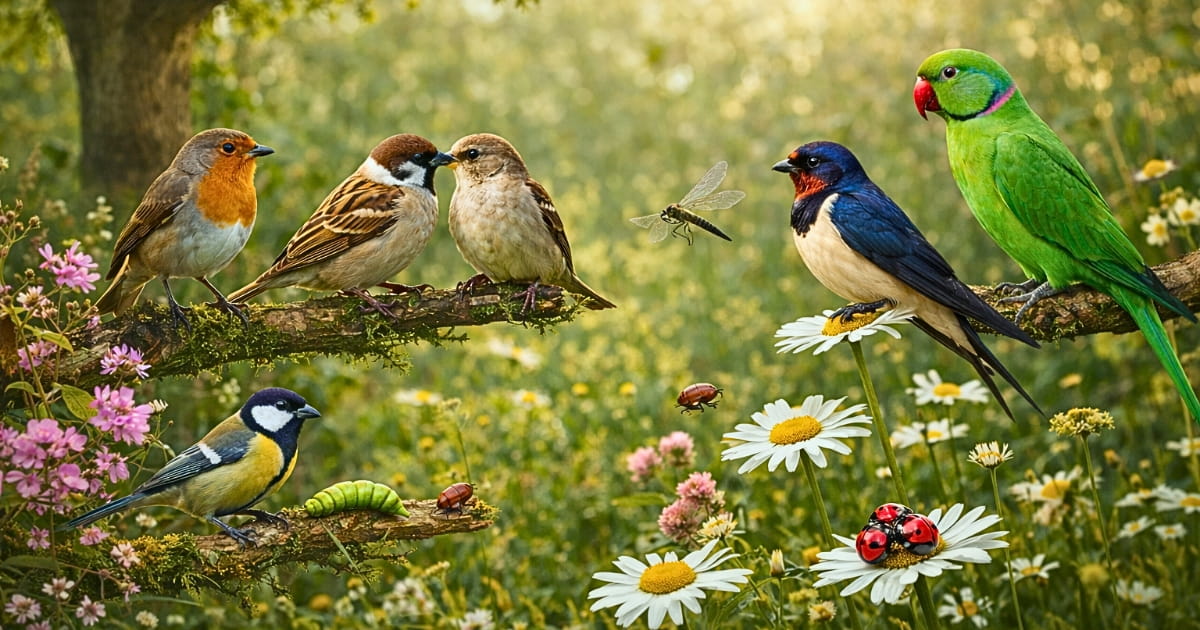

Birds: Silent Guardians of Nature, Protecting Earth’s Balance by Eating Millions of Tons of Insects Every Year
When a bird chirps from the branch of a tree with the first rays of the morning sun, it is not merely a sweet sound. It is a message from nature. It is a sign that life is still beating, the air is still alive, the trees are still breathing, and the balance of the Earth has not yet been completely broken.
Many of us associate birds with beauty, peace, and the softness of nature. Some see sparrows as a symbol of warmth and belonging, some hear the cuckoo as a sign of changing seasons, some consider the peacock a messenger of rain, while others feel that the chirping of birds brings life into a home. But the role of birds is far greater than this. They are not merely symbols of beauty — they are part of the Earth’s natural defense system.
Scientific studies show that insect-eating birds around the world consume nearly 400–500 million metric tons of insects and other arthropods every year. Researchers arrived at this estimate after reviewing 103 studies and concluded that this enormous quantity makes birds exceptionally important for the ecological balance of the planet. The study also found that more than 70% of this total consumption comes from birds living in forest ecosystems, meaning that forest birds make the largest contribution to insect control.
What Do Scientific Facts Tell Us?
In an important study published in 2018, scientists analyzed the amount of prey consumed by insectivorous birds across different biomes of the world — such as forests, grasslands, agricultural landscapes, deserts, and tundra. Their conclusion was that insectivorous birds worldwide consume around 400 to 500 million tons of insects, flies, beetles, moths, ants, aphids, grasshoppers, crickets, larvae, and other arthropods every year. Researchers also noted that the real figure is more likely to be toward the lower end of this range, yet even then, it is extraordinarily large.
A report by the University of Basel explained this finding in simple terms by stating that the annual energy consumption of insect-eating birds worldwide is comparable to that of a large metropolitan city. According to the same report, the total global biomass of birds is around 3 million tons, yet they consume many times their own body weight in insects and other arthropods every year.
A ScienceDaily report also emphasized that the role of birds is not merely “interesting,” but highly important for both ecology and agriculture, because they help control populations of plant-eating insects that could otherwise cause large-scale damage to forests and crops.
Birds Do Not Just Feed — They Also Protect
When a bird eats an insect, it is not only taking food for itself — in many cases, it is also protecting a plant. When a small bird carries away a larva, it is not simply gathering food for its chick, but also saving a leaf, a tender shoot, a small plant, a farm, a garden, or even an entire tree from possible damage.
Many systems in nature work invisibly. Human beings often understand only those things that are immediately visible: machines, sprays, medicines, technology. But nature’s own biological systems are far more subtle and profound. Birds are part of those subtle systems. They are living pillars of natural pest control.
What happens if birds are no longer there?
Many insect populations may grow out of balance.
Attacks on leaves may increase.
Plant growth may be disrupted.
Crops may suffer more damage.
Dependence on chemical pesticides may rise.
And ultimately, the effects may spread to soil, water, pollination, biodiversity, and human health.
That is why the conservation of birds is not “only for birds.” It is for farms. It is for forests. It is for the food chain. It is for the future of humankind.
Why Is the Role of Birds Greatest in Forests?
According to the study, more than 70% of the total global prey consumption by insectivorous birds comes from forests. The meaning is very clear — forests and birds are deeply connected partners in life. Forests provide birds with shelter, food, nesting spaces, and safety; and birds help protect forests from excessive insect pressure.
Forest ecosystems contain large numbers of caterpillars, beetles, leaf-eating insects, and many other arthropods. If these populations grow beyond control, leaves may wither, tree growth may be affected, and in the long run the entire forest system may weaken. In such situations, birds work like guardians of nature. They may not eliminate imbalance completely, but they prevent it from reaching a destructive level.
This is why when forests are cut down, not only are trees lost — the homes of birds are lost too. Once birds disappear, the natural system of insect control weakens, and gradually the entire ecological balance begins to break down.
The Importance of Birds in Farms, Orchards, and Villages
In our villages and small towns, sparrows, mynas, bulbuls, swallows, magpie robins, rollers, bee-eaters, drongos, woodpeckers, and many other small birds were once common sights. Today, in many places, they are seen far less often. The reason is not just urbanization, but also the destruction of habitats, chemical use, the cutting of old trees, the disappearance of open spaces, and the transformation of traditional homes into closed modern structures.
Even a small bird does very important work.
It eats insects.
It catches more insects for its young.
It reduces many harmful larvae.
And it supports the ecological system that we often take for granted as just “ordinary nature.”
When excessive pesticides are used in fields, a vicious cycle begins. Insects die, but so do beneficial organisms. Food sources for birds decline. In some cases, toxic effects also reach birds directly. The result is that over time, natural balance becomes weaker, and dependence on chemicals keeps increasing.
This is where a vision like Shristimitraa becomes deeply important — a vision that says we should not rule over nature, but learn to cooperate with it.
Shristimitraa’s Perspective: Help • Grow • Save
The message of Shristimitraa is not only an emotional appeal, but also connected to a scientific understanding of nature.
Help
When a bird is injured, thirsty, suffering in the heat, fallen from its nest, or caught in an accident — our compassion is not just kindness, but also ecological responsibility. Saving one bird is often not only saving one life, but also preserving the role that bird plays in nature.
Grow
If trees grow, birds will grow too.
If native plant species are present, the balance between insects and birds will remain stable.
If there are shrubs, open corners, safe nesting spaces, and water sources, bird life will survive.
That is why plantation is not only about greenery — it is also about bird conservation.
Save
When we protect birds, we protect nature’s system of insect control.
When we speak against the indiscriminate use of pesticides, we protect both birds and soil.
When we teach children about the importance of sparrows, parrots, mynas, bulbuls, cuckoos, green pigeons, owls, pigeons, and woodpeckers, we protect the environmental awareness of the future.
In other words, Shristimitraa’s Help • Grow • Save is not merely a slogan — it is a principle of co-existence with the Earth.
What Should We Do?
This is not a subject only to be read about — it is a subject to act upon. In our homes, courtyards, farms, schools, temples, gaushalas, hospitals, neighborhoods, and villages, small steps can create a very large change.
Protect old trees.
Plant native species.
Keep water bowls for birds in summer.
Install sparrow houses and safe nesting boxes.
Reduce unnecessary use of chemical pesticides.
Teach children to identify birds and understand their importance.
Build local networks for the treatment and rescue of injured birds.
And most importantly — do not ignore birds by thinking they are “ordinary.”
The survival of one sparrow matters.
One bowl of water matters.
One saved tree matters.
One safe nest matters.
One sensitive child matters.
In nature, the cumulative effect of small acts can be enormous.
If Birds Decline, What Else Will Decline?
Not only birdsong.
Not only beauty.
Not only the sound of morning.
Natural insect control will decline.
The balance of biodiversity will weaken.
The safety of trees and plants will reduce.
The natural resilience of farms will diminish.
And humanity’s partnership with nature will grow weaker.
Slowly, artificial intervention will increase, dependence on chemicals will rise, environmental stress will intensify, and life itself will become more imbalanced.
Conclusion: Saving Birds Means Saving the Future
Today, the need is not merely to photograph birds, hear their songs, or consider them symbols of good fortune. The real need is to understand them. To recognize their role. To preserve space for them. And to accept that they are not only companions on this Earth, but also its protectors.
The fact that insect-eating birds of the world consume 400–500 million tons of prey every year is no small matter. It shows how deeply birds contribute at the global level to insect control, forest protection, and ecological balance. And when science tells us this, our sensitivity and our responsibility should both become stronger.
So let us look at birds not only with affection, but also with understanding. Let us see them not only as creatures deserving pity, but as co-guardians of the Earth. Let us keep water for them, save trees, create nests, reduce poison, and teach children that a bird is not just a bird — it is a living link in the balance of life.
Shristimitraa’s Resolve:
Save birds.
Save nature.
Save the future.
पक्षी: प्रकृति के मौन प्रहरी, जो हर वर्ष करोड़ों टन कीट खाकर धरती का संतुलन बचाते हैं
जब सुबह की पहली किरण के साथ किसी पेड़ की शाखा पर बैठी चिड़िया चहकती है, तो वह केवल एक मधुर ध्वनि नहीं होती। वह प्रकृति का संदेश होती है। वह संकेत होता है कि जीवन अभी भी धड़क रहा है, हवा अभी भी जीवित है, पेड़ अभी भी सांस ले रहे हैं, और पृथ्वी पर संतुलन अभी भी पूरी तरह टूटा नहीं है।
हममें से बहुत से लोग पक्षियों को सुंदरता, शांति और प्रकृति की कोमलता से जोड़ते हैं। कोई गौरैया को अपनापन मानता है, कोई कोयल को ऋतु का संकेत, कोई मोर को वर्षा का दूत, तो कोई चिड़ियों की चहचहाहट को घर की जीवंतता। लेकिन पक्षियों की भूमिका इससे कहीं बड़ी है। वे केवल सौंदर्य के प्रतीक नहीं हैं — वे पृथ्वी के प्राकृतिक सुरक्षा तंत्र का हिस्सा हैं।
वैज्ञानिक अध्ययन बताते हैं कि दुनिया के कीटभक्षी पक्षी हर वर्ष लगभग 400–500 मिलियन मीट्रिक टन कीट और अन्य आर्थ्रोपोड खाते हैं। शोधकर्ताओं ने यह अनुमान 103 अध्ययनों की समीक्षा के आधार पर तैयार किया, और निष्कर्ष निकाला कि यह मात्रा पृथ्वी के पारिस्थितिक संतुलन में पक्षियों की भूमिका को असाधारण रूप से महत्वपूर्ण बनाती है। अध्ययन में यह भी पाया गया कि इस कुल उपभोग का 70% से अधिक हिस्सा वन क्षेत्रों के पक्षियों से आता है, यानी जंगलों में रहने वाले पक्षी कीट नियंत्रण में सबसे बड़ा योगदान देते हैं।
वैज्ञानिक तथ्य हमें क्या बताते हैं?
2018 में प्रकाशित एक महत्वपूर्ण अध्ययन में वैज्ञानिकों ने दुनिया के अलग-अलग बायोम — जैसे वन, घासभूमि, कृषि क्षेत्र, रेगिस्तान और टुंड्रा — में कीटभक्षी पक्षियों द्वारा खाए जाने वाले शिकार की मात्रा का तुलनात्मक विश्लेषण किया। उनका निष्कर्ष था कि दुनिया भर के insectivorous birds हर वर्ष लगभग 400 से 500 मिलियन टन तक कीट, मक्खियाँ, भृंग, पतंगे, चींटियाँ, एफिड्स, टिड्डे, झींगुर, लार्वा और अन्य आर्थ्रोपोड खाते हैं। शोधकर्ताओं ने यह भी कहा कि वास्तविक मान इस सीमा के निचले हिस्से के पास होने की अधिक संभावना है, फिर भी यह संख्या स्वयं में अत्यंत विशाल है।
University of Basel की रिपोर्ट में इस निष्कर्ष को आम भाषा में समझाते हुए कहा गया कि दुनिया के कीटभक्षी पक्षियों की वार्षिक ऊर्जा-खपत एक बड़े महानगर के स्तर की है। उसी रिपोर्ट के अनुसार, पक्षियों का कुल वैश्विक जैवभार लगभग 3 मिलियन टन के आसपास है, लेकिन वे हर वर्ष अपने वजन से कई गुना अधिक मात्रा में कीट और अन्य आर्थ्रोपोड खा जाते हैं।
ScienceDaily की रिपोर्ट ने भी यही रेखांकित किया कि पक्षियों की यह भूमिका केवल “रोचक” नहीं, बल्कि पारिस्थितिकी और कृषि दोनों के लिए अत्यंत महत्वपूर्ण है, क्योंकि वे उन plant-eating insects की आबादी को नियंत्रित करने में मदद करते हैं जो अन्यथा जंगलों और फसलों को बड़े पैमाने पर नुकसान पहुँचा सकते हैं।
पक्षी सिर्फ खाते नहीं, बचाते भी हैं
जब कोई पक्षी एक कीट खाता है, तो यह केवल उसका भोजन नहीं होता — कई बार वह एक पौधे की रक्षा भी होती है। जब कोई चिड़िया लार्वा उठाकर ले जाती है, तो वह केवल अपने बच्चे के लिए आहार नहीं जुटा रही होती, बल्कि वह एक पत्ती, एक नई कोंपल, एक छोटे पौधे, एक खेत, एक बगीचे या एक पूरे पेड़ को संभावित नुकसान से भी बचा रही होती है।
प्रकृति में बहुत-सी व्यवस्थाएँ अदृश्य रूप से काम करती हैं। मनुष्य को अक्सर वही चीज़ समझ में आती है जो तुरंत दिखे: मशीन, स्प्रे, दवा, तकनीक। लेकिन प्रकृति के अपने जैविक तंत्र कहीं अधिक सूक्ष्म और गहरे होते हैं। पक्षी उन्हीं सूक्ष्म तंत्रों का हिस्सा हैं। वे pest control के जीवित स्तंभ हैं।
अगर पक्षी न हों, तो क्या होगा?
कीटों की कई आबादियाँ असंतुलित रूप से बढ़ सकती हैं।
पत्तियों पर हमला बढ़ सकता है।
वनस्पतियों की वृद्धि बाधित हो सकती है।
फसलें अधिक प्रभावित हो सकती हैं।
रासायनिक कीटनाशकों पर निर्भरता बढ़ सकती है।
और अंततः इसका असर मिट्टी, जल, परागण, जैव विविधता और मानव स्वास्थ्य तक पहुँच सकता है।
इसलिए पक्षियों का संरक्षण “केवल पक्षियों के लिए” नहीं है। यह खेतों के लिए है। यह जंगलों के लिए है। यह भोजन शृंखला के लिए है। यह मानव भविष्य के लिए है।
जंगलों में पक्षियों की भूमिका सबसे बड़ी क्यों है?
अध्ययन के अनुसार, कीटभक्षी पक्षियों के कुल वैश्विक शिकार-उपभोग का 70% से अधिक हिस्सा वनों से आता है। इसका अर्थ बहुत स्पष्ट है — जंगल और पक्षी एक-दूसरे के जीवनसाथी हैं। जंगल पक्षियों को आश्रय, भोजन, घोंसले और सुरक्षा देते हैं; और पक्षी जंगलों को कीटों के अत्यधिक दबाव से बचाने में सहायता करते हैं।
वन क्षेत्रों में कैटरपिलर, बीटल्स, पत्तियाँ खाने वाले कीट और अनेक प्रकार के आर्थ्रोपोड बड़ी मात्रा में पाए जाते हैं। यदि इनकी संख्या नियंत्रण से बाहर हो जाए, तो पत्तियाँ झुलस सकती हैं, वृक्षों की वृद्धि प्रभावित हो सकती है, और लंबे समय में पूरा वन तंत्र कमजोर पड़ सकता है। ऐसे में पक्षी प्रकृति के प्रहरी की तरह काम करते हैं। वे असंतुलन को पूरी तरह समाप्त तो नहीं करते, लेकिन उसे विनाशकारी स्तर तक जाने से रोकते हैं।
यही कारण है कि जहाँ जंगल कटते हैं, वहाँ केवल पेड़ नहीं जाते — वहाँ पक्षियों का बसेरा जाता है, फिर उनके जाने से कीट नियंत्रण का प्राकृतिक तंत्र कमजोर होता है, और फिर पूरा पारिस्थितिक संतुलन धीरे-धीरे टूटने लगता है।
खेतों, बागों और गाँवों में पक्षियों का महत्व
हमारे गाँवों और कस्बों में कभी गौरैया, मैना, बुलबुल, अबाबील, दहियाल, नीलकंठ, बी-ईटर, ड्रोंगो, कठफोड़वा और अनेक छोटे पक्षी आम दृश्य हुआ करते थे। आज कई जगह वे कम दिखने लगे हैं। इसका कारण केवल शहरीकरण नहीं, बल्कि आवासों का नष्ट होना, रासायनिक उपयोग, पुराने पेड़ों का कटना, खुली जगहों का समाप्त होना, और पारंपरिक घरों का आधुनिक बंद ढाँचों में बदलना भी है।
एक छोटा पक्षी भी बहुत बड़ा काम करता है।
वह कीट खाता है।
अपने बच्चों के लिए और कीट पकड़ता है।
कई हानिकारक लार्वा कम करता है।
और उस पारिस्थितिकी को सहारा देता है जिसे हम केवल “सामान्य प्रकृति” समझते हैं।
जब खेतों में अत्यधिक कीटनाशकों का प्रयोग होता है, तो एक दुष्चक्र बनता है। कीट तो मरते ही हैं, साथ में लाभकारी जीव भी प्रभावित होते हैं। पक्षियों के भोजन के स्रोत कम होते हैं। कभी-कभी विषाक्त प्रभाव सीधे पक्षियों तक भी पहुँचते हैं। परिणाम यह कि लंबे समय में प्राकृतिक संतुलन और कमजोर होता जाता है, और रसायनों पर निर्भरता बढ़ती चली जाती है।
Shristimitraa जैसी सोच यहाँ अत्यंत जरूरी हो जाती है — ऐसी सोच जो कहे कि प्रकृति पर राज नहीं करना, उसके साथ सहयोग करना सीखो।
Shristimitraa का दृष्टिकोण: Help • Grow • Save
Shristimitraa का संदेश केवल भावनात्मक अपील नहीं, बल्कि प्रकृति की वैज्ञानिक समझ से भी जुड़ा हुआ है।
Help
जब कोई पक्षी घायल हो, प्यासा हो, गर्मी में तड़प रहा हो, घोंसले से गिर गया हो, या किसी दुर्घटना का शिकार हुआ हो — तब हमारी संवेदना केवल दया नहीं, बल्कि पारिस्थितिक जिम्मेदारी भी है। एक पक्षी को बचाना कई बार केवल एक जीवन को बचाना नहीं, बल्कि उस भूमिका को बचाना भी है जो वह प्रकृति में निभाता है।
Grow
पेड़ बढ़ेंगे तो पक्षी बढ़ेंगे।
स्थानीय प्रजातियों के पौधे होंगे तो कीटों और पक्षियों का संतुलन बना रहेगा।
झाड़ियाँ, खुले कोने, सुरक्षित घोंसला-स्थल और पानी के स्रोत होंगे तो पक्षियों का जीवन बचेगा।
इसलिए वृक्षारोपण केवल हरियाली नहीं, पक्षी-संरक्षण भी है।
Save
जब हम पक्षियों को बचाते हैं, तो हम कीट नियंत्रण की प्राकृतिक व्यवस्था को बचाते हैं।
जब हम कीटनाशकों के अंधाधुंध उपयोग को कम करने की बात करते हैं, तो हम पक्षियों और मिट्टी दोनों को बचाते हैं।
जब हम बच्चों को गौरैया, तोता, मैना, बुलबुल, कोयल, हरियल, उल्लू, कबूतर, कठफोड़वा के महत्व के बारे में बताते हैं, तो हम भविष्य की पर्यावरणीय चेतना को बचाते हैं।
यानी Shristimitraa का Help • Grow • Save कोई नारा भर नहीं है — यह पृथ्वी के साथ सह-अस्तित्व का सूत्र है।
हमें क्या करना चाहिए?
यह विषय केवल पढ़ने का नहीं, करने का है। हम अपने घर, आँगन, खेत, स्कूल, मंदिर, गौशाला, अस्पताल, मोहल्ले और गाँव स्तर पर छोटे-छोटे कदम उठाकर बहुत बड़ा परिवर्तन ला सकते हैं।
पुराने पेड़ बचाइए।
स्थानीय प्रजातियों के पौधे लगाइए।
गर्मियों में परिंडे रखिए।
गौरैया घर और सुरक्षित nesting boxes लगाइए।
रासायनिक कीटनाशकों का अनावश्यक उपयोग कम कीजिए।
बच्चों को पक्षियों की पहचान और महत्व सिखाइए।
घायल पक्षियों के उपचार के लिए स्थानीय नेटवर्क बनाइए।
और सबसे महत्वपूर्ण — पक्षियों को “साधारण” समझकर अनदेखा मत कीजिए।
एक गौरैया का बचना महत्व रखता है।
एक पानी का पात्र महत्व रखता है।
एक बचा हुआ पेड़ महत्व रखता है।
एक सुरक्षित घोंसला महत्व रखता है।
एक संवेदनशील बच्चा महत्व रखता है।
प्रकृति में छोटे कार्यों का संचयी प्रभाव बहुत बड़ा होता है।
पक्षी घटेंगे तो क्या घटेगा?
सिर्फ चहचहाहट नहीं।
सिर्फ सौंदर्य नहीं।
सिर्फ सुबह की आवाज़ नहीं।
घटेगा प्राकृतिक कीट नियंत्रण।
घटेगी जैव विविधता का संतुलन।
घटेगी पेड़ों और पौधों की सुरक्षा।
घटेगी खेतों की प्राकृतिक सहनशक्ति।
घटेगी प्रकृति के साथ मनुष्य की साझेदारी।
और धीरे-धीरे बढ़ेगा कृत्रिम हस्तक्षेप, रसायनों पर निर्भरता, पर्यावरणीय तनाव और जीवन का असंतुलन।
निष्कर्ष: पक्षियों को बचाना, भविष्य को बचाना है
आज आवश्यकता यह नहीं कि हम केवल पक्षियों की फोटो लें, उनके गीत सुनें या उन्हें शुभ संकेत मानें। आवश्यकता यह है कि हम उन्हें समझें। उनकी भूमिका को पहचानें। उनके लिए स्थान बचाएँ। और यह स्वीकार करें कि वे इस पृथ्वी के सहयात्री ही नहीं, संरक्षक भी हैं।
दुनिया के कीटभक्षी पक्षियों द्वारा हर वर्ष 400–500 मिलियन टन शिकार का उपभोग कोई छोटी बात नहीं है। यह बताता है कि पक्षी वैश्विक स्तर पर कीट नियंत्रण, वन संरक्षण और पारिस्थितिक संतुलन में कितनी गहरी भूमिका निभाते हैं। और जब विज्ञान यह कहता है, तो हमारी संवेदना और जिम्मेदारी दोनों और मजबूत हो जानी चाहिए।
इसलिए आइए, हम पक्षियों को केवल प्रेम से नहीं, समझदारी से भी देखें। उन्हें केवल दया के पात्र नहीं, धरती के सह-रक्षक मानें। उनके लिए पानी रखें, पेड़ बचाएँ, घोंसले बनाएं, ज़हर कम करें, और बच्चों को सिखाएँ कि चिड़िया सिर्फ चिड़िया नहीं होती — वह जीवन के संतुलन की एक चलती-फिरती कड़ी होती है।
Shristimitraa का प्रण:
पक्षियों को बचाएँ।
प्रकृति को बचाएँ।
भविष्य को बचाएँ।