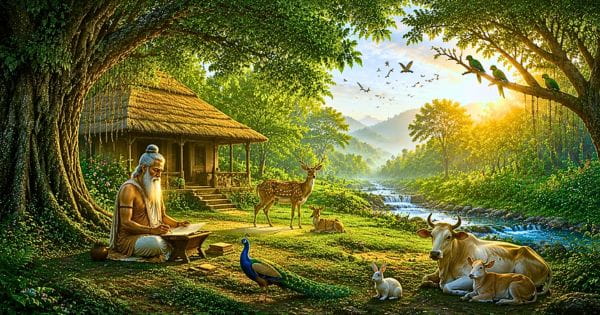

Indian View of Life Connected with Nature
With the development of human civilization, man's relationship to nature has also been changing. There was a time when man considered himself a part of nature and lived in balance with it.
In the Indian Rishi tradition, nature was not considered merely an object of use, but rather the basis of life, knowledge, and consciousness.
Respect for forests, rivers, mountains, animals, birds, and the five elements was part of this thinking.
Forest: Not just a group of trees, but an ashram of life
In ancient India, the ashrams of many sages and saints were located in forest areas.
Forests were not just places to live, but also:
- Centers of knowledge and spiritual practice.
- Natural habitats for various creatures.
- They were a means to understand the balance between humans and nature.
The Rishi tradition conveyed the message that true knowledge of life can be gained not by distancing oneself from nature, but by connecting with it.
Respect for the Five Elements
In Indian philosophy, earth, water, fire, air, and space are called the five elements.
These elements were considered the basis of life, and their balance was considered important.
Today, modern science also tells us that:
- Clean air is essential for life.
- Water conservation is future security.
- Healthy soil is the foundation of food and biodiversity.
Sacred Forests and Community-Based Conservation
Traditions such as Dev Van, Oran, and Sacred Groves are still prevalent in many regions of India.
In these areas, trees and animals continue to be protected due to religious and cultural beliefs.
This tradition connects with an important principle of modern conservation— nature conservation with the participation of local communities.
Compassion for Animals and Birds
The spirit of compassion and non-violence towards all living beings has been important in Indian philosophy.
This sentiment was not merely a religious idea, but a vision of the balance of life.
Today, wildlife conservation also emphasizes that every living organism plays a role in the Earth's ecosystem.
Modern Conservation Science and Ancient Wisdom
The objective of modern conservation science is:
- Protecting biodiversity.
- Balanced use of natural resources.
- Conserving wildlife and their habitats.
- Preserving nature for future generations.
The language of ancient Indian vision and modern science may be different, but the objective of both is to maintain the balance of nature.
Were our ancestors protectors of nature?
It would be fair to say that ancient Indian society had a strong sense of respect and responsibility for nature.
Although human society still utilized nature, there were many traditions that promoted a balanced life and limited consumption.
Today, there is a need to combine that sensitive approach with modern science.
Shristi Mitraa and Nature Conservation
Shristi Mitraa's efforts are also linked to the idea of establishing a balanced relationship with nature and living beings.
- Tree planting and green space creation
- Natural habitat conservation
- Animal and bird care
- Environmental awareness
All these efforts are steps towards viewing nature not just as a resource, but as a partner in life.
Conclusion
The Rishi tradition teaches us that respect for nature is not just a necessity, but a life value.
Modern science tells us that maintaining the balance of nature is essential for our survival.
Only the combination of ancient knowledge and modern science can show the way to a safe future for the Earth.
प्रकृति के साथ जुड़ी भारतीय जीवन दृष्टि
मानव सभ्यता के विकास के साथ प्रकृति के प्रति मनुष्य का संबंध भी बदलता रहा है। एक समय ऐसा था जब मनुष्य स्वयं को प्रकृति का हिस्सा मानकर उसके साथ संतुलन में जीवन जीता था।
भारतीय ऋषि परंपरा में प्रकृति को केवल उपयोग की वस्तु नहीं माना गया, बल्कि उसे जीवन, ज्ञान और चेतना का आधार समझा गया।
वन, नदियां, पर्वत, पशु-पक्षी और पंचमहाभूतों के प्रति सम्मान इसी सोच का हिस्सा थे।
वन: केवल पेड़ों का समूह नहीं, जीवन का आश्रम
प्राचीन भारत में अनेक ऋषि-मुनियों के आश्रम वन क्षेत्रों में स्थित थे।
वन केवल रहने का स्थान नहीं थे, बल्कि:
- ज्ञान और साधना के केंद्र थे।
- विभिन्न जीवों के प्राकृतिक आवास थे।
- मानव और प्रकृति के संतुलन को समझने का माध्यम थे।
ऋषि परंपरा यह संदेश देती थी कि प्रकृति से दूर होकर नहीं, बल्कि उसके साथ जुड़कर जीवन का वास्तविक ज्ञान प्राप्त किया जा सकता है।
पंचमहाभूतों के प्रति सम्मान
भारतीय दर्शन में पृथ्वी, जल, अग्नि, वायु और आकाश को पंचमहाभूत कहा गया है।
इन तत्वों को जीवन का आधार माना गया और इनके संतुलन को महत्वपूर्ण समझा गया।
आज आधुनिक विज्ञान भी बताता है कि:
- स्वच्छ वायु जीवन के लिए आवश्यक है।
- जल संरक्षण भविष्य की सुरक्षा है।
- स्वस्थ मिट्टी भोजन और जैव विविधता का आधार है।
पवित्र वन और समुदाय आधारित संरक्षण
भारत के अनेक क्षेत्रों में आज भी देव वन, ओरण और पवित्र उपवन जैसी परंपराएं देखने को मिलती हैं।
इन क्षेत्रों में धार्मिक और सांस्कृतिक मान्यताओं के कारण पेड़ों और जीवों की रक्षा होती रही।
यह परंपरा आधुनिक Conservation के एक महत्वपूर्ण सिद्धांत से जुड़ती है— स्थानीय समुदायों की भागीदारी से प्रकृति संरक्षण।
पशु-पक्षियों के प्रति संवेदना
भारतीय दर्शन में सभी जीवों के प्रति करुणा और अहिंसा का भाव महत्वपूर्ण रहा है।
यह भावना केवल धार्मिक विचार नहीं थी, बल्कि जीवन के संतुलन को समझने की एक दृष्टि थी।
आज Wildlife Conservation भी यही बताता है कि प्रत्येक जीव पृथ्वी के पारिस्थितिकी तंत्र में अपनी भूमिका निभाता है।
आधुनिक Conservation Science और प्राचीन ज्ञान
आधुनिक संरक्षण विज्ञान (Conservation Science) का उद्देश्य है:
- जैव विविधता की रक्षा करना।
- प्राकृतिक संसाधनों का संतुलित उपयोग।
- वन्य जीवों और उनके आवासों का संरक्षण।
- आने वाली पीढ़ियों के लिए प्रकृति को सुरक्षित रखना।
प्राचीन भारतीय दृष्टि और आधुनिक विज्ञान की भाषा अलग हो सकती है, लेकिन दोनों का उद्देश्य प्रकृति के संतुलन को बनाए रखना है।
क्या हमारे पूर्वज प्रकृति के संरक्षक थे?
यह कहना उचित होगा कि प्राचीन भारतीय समाज में प्रकृति के प्रति सम्मान और जिम्मेदारी की भावना मजबूत थी।
हालांकि उस समय भी मानव समाज प्रकृति का उपयोग करता था, लेकिन कई परंपराएं ऐसी थीं जो संतुलित जीवन और सीमित उपभोग को बढ़ावा देती थीं।
आज आवश्यकता है कि हम उस संवेदनशील दृष्टि को आधुनिक विज्ञान के साथ जोड़ें।
Shristi Mitraa और प्रकृति संरक्षण
Shristi Mitraa का प्रयास भी इसी विचार से जुड़ा है कि प्रकृति और जीवों के साथ संतुलित संबंध स्थापित किया जाए।
- वृक्षारोपण और हरित क्षेत्र निर्माण
- प्राकृतिक आवास संरक्षण
- पशु-पक्षी सेवा
- पर्यावरण जागरूकता
ये सभी प्रयास प्रकृति को केवल संसाधन नहीं, बल्कि जीवन के साथी के रूप में देखने की दिशा में कदम हैं।
निष्कर्ष
ऋषि परंपरा हमें सिखाती है कि प्रकृति के प्रति सम्मान केवल आवश्यकता नहीं, बल्कि जीवन मूल्य है।
आधुनिक विज्ञान हमें बताता है कि प्रकृति का संतुलन बनाए रखना हमारे अस्तित्व के लिए आवश्यक है।
प्राचीन ज्ञान और आधुनिक विज्ञान का मेल ही पृथ्वी के सुरक्षित भविष्य का मार्ग दिखा सकता है।