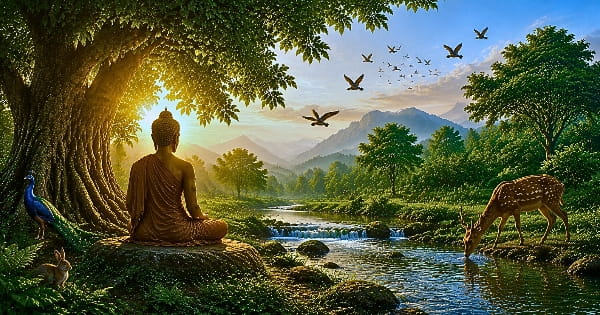

The Unity of Life in the Buddha's Vision
Lord Buddha did not view human life as limited solely to human beings; instead, he saw all life as an interconnected system.
The core foundation of his teachings was compassion, non-violence, and awareness. Buddha's message was that all beings desire happiness and wish to avoid suffering.
It is this very sentiment that makes us sensitive towards nature and all living beings.
Pratityasamutpada: The Principle of Interdependence
One of the Buddha's significant principles is:
Pratityasamutpada (Dependent Origination)
This means that nothing in the world exists independently; rather, everything comes into existence through the convergence of various causes and conditions.
Consider a tree: it does not originate from a seed alone but develops through the contribution of soil, water, sunlight, air, and numerous microorganisms.
Similarly, human life is deeply interconnected with nature and other living beings.
Compassion: Empathy for All Living Beings
The Buddha preached a message of loving-kindness and compassion towards all beings.
His teachings convey that humans should not harm other living beings or nature for the sake of their own happiness.
Compassion is not merely an emotion but a responsibility in how we live our lives.
The Environmental Significance of the Buddha's Non-Violence
Non-violence does not simply mean refraining from violence against humans; it also entails respecting life itself.
When we destroy forests, pollute water sources, or obliterate the natural habitats of living beings, we disrupt the balance of life.
The Bodhi Tree: A Symbol of Nature and Consciousness
The Bodhi Tree—the tree beneath which Lord Buddha attained enlightenment—remains a symbol of nature and spiritual awakening to this day.
It reminds us that nature is not merely the external world but is also deeply connected to the evolution of human consciousness.
Modern Ecology and Buddha's Message
Modern environmental science reveals that all living beings on Earth are interconnected.
- Forests influence the climate and the water cycle.
- Birds and insects maintain biodiversity.
- Soil microorganisms are a vital part of the life cycle.
- The loss of a single species can impact the entire ecosystem.
Science calls this an "ecosystem," while Buddha's teachings explain it as "interdependence."
Balance Between Humanity and Nature
One reason for today's environmental crisis is that humans have begun to view themselves as separate from nature.
Buddha's teachings remind us that our existence is inextricably linked to the earth, water, air, and all living beings.
Living in balance with nature is true wisdom.
Shristi Mitraa and the Path of Compassion
The work of Shristi Mitraa is also inspired by the conviction that every living being is significant.
- Assisting injured animals and birds
- Creating safe spaces for living beings
- Conserving natural habitats
- Promoting environmental awareness
These efforts represent small steps toward strengthening the bond of compassion and balance between humanity and nature.
Conclusion
Lord Buddha's message is profoundly relevant in the context of today's environmental crisis.
When we realize that we are not separate from nature but rather a part of it, our lives become more sensitive and responsible.
All life is interconnected, and respecting this interconnectedness is compassion.
बुद्ध की दृष्टि में जीवन की एकता
भगवान बुद्ध ने मानव जीवन को केवल मनुष्य तक सीमित नहीं माना, बल्कि सम्पूर्ण जीवन को एक जुड़े हुए तंत्र के रूप में देखा।
उनकी शिक्षाओं का मूल आधार करुणा, अहिंसा और जागरूकता था। बुद्ध का संदेश था कि सभी प्राणी सुख चाहते हैं और दुख से बचना चाहते हैं।
यही भावना हमें प्रकृति और सभी जीवों के प्रति संवेदनशील बनाती है।
प्रतित्यसमुत्पाद: परस्पर निर्भरता का सिद्धांत
बुद्ध का एक महत्वपूर्ण सिद्धांत है:
प्रतित्यसमुत्पाद (Dependent Origination)
इसका अर्थ है कि संसार की कोई भी वस्तु अपने आप में स्वतंत्र नहीं है, बल्कि अनेक कारणों और परिस्थितियों के सहयोग से अस्तित्व में आती है।
एक वृक्ष को ही देखें। वह केवल बीज से नहीं बनता, बल्कि मिट्टी, जल, सूर्य, वायु और अनेक सूक्ष्म जीवों के सहयोग से विकसित होता है।
इसी प्रकार मानव जीवन भी प्रकृति और अन्य जीवों से गहराई से जुड़ा हुआ है।
करुणा: सभी जीवों के प्रति संवेदना
बुद्ध ने सभी प्राणियों के प्रति मैत्री और करुणा का संदेश दिया।
उनकी शिक्षा हमें यह समझाती है कि मनुष्य को अपने सुख के लिए अन्य जीवों और प्रकृति को नुकसान नहीं पहुंचाना चाहिए।
करुणा केवल एक भावना नहीं, बल्कि जीवन जीने की जिम्मेदारी है।
बुद्ध और अहिंसा का पर्यावरणीय अर्थ
अहिंसा का अर्थ केवल मनुष्य के प्रति हिंसा न करना नहीं है, बल्कि जीवन के प्रति सम्मान रखना भी है।
जब हम जंगलों को नष्ट करते हैं, जल स्रोतों को प्रदूषित करते हैं या जीवों के प्राकृतिक आवास समाप्त करते हैं, तो हम जीवन के संतुलन को प्रभावित करते हैं।
बोधि वृक्ष: प्रकृति और चेतना का प्रतीक
भगवान बुद्ध को ज्ञान की प्राप्ति जिस वृक्ष के नीचे हुई, वह बोधि वृक्ष आज भी प्रकृति और आध्यात्मिक जागृति का प्रतीक माना जाता है।
यह हमें याद दिलाता है कि प्रकृति केवल बाहरी संसार नहीं है, बल्कि मानव चेतना के विकास से भी जुड़ी हुई है।
आधुनिक Ecology और बुद्ध का संदेश
आधुनिक पर्यावरण विज्ञान बताता है कि पृथ्वी पर सभी जीव एक-दूसरे से जुड़े हुए हैं।
- वन जलवायु और जल चक्र को प्रभावित करते हैं।
- पक्षी और कीट जैव विविधता बनाए रखते हैं।
- मिट्टी के सूक्ष्म जीव जीवन चक्र का महत्वपूर्ण हिस्सा हैं।
- एक प्रजाति का नुकसान पूरे पारिस्थितिकी तंत्र को प्रभावित कर सकता है।
विज्ञान इसे Ecosystem कहता है और बुद्ध की शिक्षा इसे परस्पर निर्भरता के रूप में समझाती है।
मानव और प्रकृति के बीच संतुलन
आज पर्यावरण संकट का एक कारण यह भी है कि मनुष्य ने स्वयं को प्रकृति से अलग समझना शुरू कर दिया है।
बुद्ध की शिक्षा हमें याद दिलाती है कि हमारा अस्तित्व पृथ्वी, जल, वायु और सभी जीवों से जुड़ा हुआ है।
प्रकृति के साथ संतुलन बनाकर जीना ही वास्तविक बुद्धिमत्ता है।
Shristi Mitraa और करुणा का मार्ग
Shristi Mitraa का कार्य भी इसी भावना से प्रेरित है कि प्रत्येक जीव महत्वपूर्ण है।
- घायल पशु-पक्षियों की सहायता
- जीवों के लिए सुरक्षित स्थान बनाना
- प्राकृतिक आवास संरक्षण
- पर्यावरण जागरूकता
ये प्रयास मानव और प्रकृति के बीच करुणा तथा संतुलन का संबंध मजबूत करने की दिशा में छोटे कदम हैं।
निष्कर्ष
भगवान बुद्ध का संदेश आज के पर्यावरण संकट के समय में अत्यंत प्रासंगिक है।
जब हम यह समझते हैं कि हम प्रकृति से अलग नहीं हैं, बल्कि उसी का हिस्सा हैं, तब हमारा जीवन अधिक संवेदनशील और जिम्मेदार बनता है।
सभी जीवन आपस में जुड़े हुए हैं, और इसी जुड़ाव का सम्मान करना ही करुणा है।